Chinese gigafactories run under 10 percent scrap. Western plants average 30 to 40 percent. Most people assume the gap is labor costs or subsidies. It isn't. The durable advantage is manufacturing maturity: 15 years of accumulated learning compressed into process control and yield[3,6]. Western plants cannot out-wait that lead. The lever that closes it is software that turns every batch into a learning signal, and that is what Niobia AI is built to do.

Why gigafactories still scrap up to 30% of early production
Scrap is the first and largest blocker, and it is brutal at scale. Scrap rates of 15 to 30 percent are normal in the first few years of cell production, and even after five years reject rates sit near ten percent[1]. The cost compounds fast: each point of scrap runs about €30,000 per day, roughly €10 million per year, so a 30 percent reject rate at full capacity burns close to €900,000 per day[1]. That single number is why yield, not throughput, is the real constraint in a gigafactory.
The root cause is a collision between throughput and tolerance. A 38 GWh per year gigafactory produces around six million cylindrical cells per day, nearly 70 cells per second, while every cell must hold geometric tolerances on the order of a few microns and stay clear of similarly sized particle contaminants[2]. Most critical defects live in the 10 to 100 micron range[2]. Miss control by a hair on a coating gap or a contaminant and you have made scrap at 70 cells per second. With cell margins often sitting at 2 to 3 percent[2], there is no room to absorb that.
The other blockers are process uncertainty and a shortage of people who can manage the complexity. The Fraunhofer FFB and RWTH PEM ramp-up study names both directly as the reasons cell output keeps landing below plan[1]. What you see on the floor matches the paper. The equipment is rarely the problem. Knowing which of hundreds of interacting parameters moved, and when, is the problem.
The US-China gap is a manufacturing-maturity gap, not a subsidy gap
The performance spread between Chinese and Western gigafactories is wide and well documented. It shows up first in scrap, then in cost, then in price.
| Dimension | China | US / West | Source |
|---|---|---|---|
| Steady-state scrap rate | Under 10% | 30 to 40% (global average) | S&P Global Mobility[3] |
| Labor cost per kWh | ~$1 to $2/kWh | ~$6/kWh | Thunder Said Energy[5] |
| Gigafactory capex | Baseline, falling | Often over 2x China, rising | Thunder Said Energy[5] |
| 2024 battery pack price decline | ~30% | 10 to 15% | IEA Global EV Outlook 2025[4] |
| Structural advantage | Vertical integration, large skilled workforce, ~15 years of learning | Higher cost base, thinner experience curve | IEA[4], Stanford FSI[6] |
The labor math is concrete. At roughly 70 employees per GWh of annual capacity, labor costs about $6/kWh at Western wages near $85,000 per person, but only $1 to $2/kWh at Chinese wages of $15,000 to $20,000[5]. Capex tells the same story, with US and Japanese plants running well over twice the cost of Chinese plants, and Western capex rising while Chinese capex falls[5].
But the durable advantage is not cheap labor. It is experience. Stanford researchers frame China's lead as a learning curve. Chinese producers cut cost and lifted yield as volume accumulated, and that compounding is hard to copy with money alone[6]. The IEA points to the same drivers: fierce domestic competition that pushed up efficiency and yield, a deep skilled workforce, and vertically integrated supply chains[4]. The honest reading for a Western plant is that you cannot out-wait a 15 year head start. You have to compress it. Software that turns every batch into a learning signal is the only lever that moves at that speed, and it is exactly where Niobia AI focuses: shortening the loop from a defect appearing to its cause being understood.
What actually limits a gigafactory: the dry room, and trial-and-error
The dry room is the quiet constraint nobody outside the industry talks about. It is the moisture-controlled space where cells are built, and it is expensive to run. The dry room consumes roughly 25 percent of a battery cell gigafactory's operating energy, second only to coating and drying[7]. Energy intensity across the whole plant is steep, with an estimated 30 to 65 kWh consumed for every kWh of cells produced[2]. That is why site selection now hinges on access to cheap, stable, low-carbon power.
The deeper limit is how process development still works. Most of it still runs on empirical trial-and-error, which is slow, costly, and wasteful of material[8]. A process engineer changes solid content, then comma gap, then coating speed, and waits to see what the electrode does. The problem is that battery production has hundreds, sometimes thousands, of interacting parameters, and which ones drive variability is often not well understood[2]. Change one and you shift another downstream without meaning to.
This is changing, and it is the most underrated opportunity in the plant. Machine learning models can map manufacturing parameters like solid content, comma gap, and coating speed directly to electrode properties, replacing trial-and-error with prediction[8]. That is the seed of a factory that learns from every batch instead of relearning the same lesson each ramp. Niobia AI is built around that shift, correlating process telemetry with the defects that show up downstream so the line tunes itself toward yield instead of guessing.
Semiconductor fabs are a generation ahead, and the mechanism is instructive
Battery plants are roughly where semiconductor fabs were decades ago, and the gap is not subtle. Fabs reach yields near 100 percent through a disciplined practice called yield learning, the systematic removal of one fault source after another until nearly every unit conforms[10]. Battery cell lines, by contrast, are still fighting ten percent steady-state scrap[1]. That difference is the whole story.
Two habits separate the two industries. First, fabs inspect after every process step, because every step can introduce a defect, while battery lines tend to inspect at a few checkpoints and hope nothing slipped through in between[2]. Second, fabs treat yield improvement as a continuous discipline, not a crisis response. Battery manufacturing has not yet built either habit at scale.
The closest the West has come to a fully automated cell plant is Tesla, which reports about 90 percent automation at its Nevada gigafactory[11]. Even that is not lights-out. True lights-out manufacturing demands something batteries cannot yet deliver: a "four nines" standard, where 99.99 percent of parts meet spec, roughly one defect per million[12]. A line that scraps ten percent is five orders of magnitude away from that bar. The lesson from fabs is not to copy their tooling. Wafers are far cleaner and more uniform inputs than wet battery chemistry. The lesson is the method: inspect at every step, close the loop, and treat yield learning as a managed program rather than a series of fire drills.
What AI in a gigafactory actually looks like: four levels
AI in a gigafactory is best understood as a ladder. Each rung depends on the one below it, and most plants today are still climbing the first two.
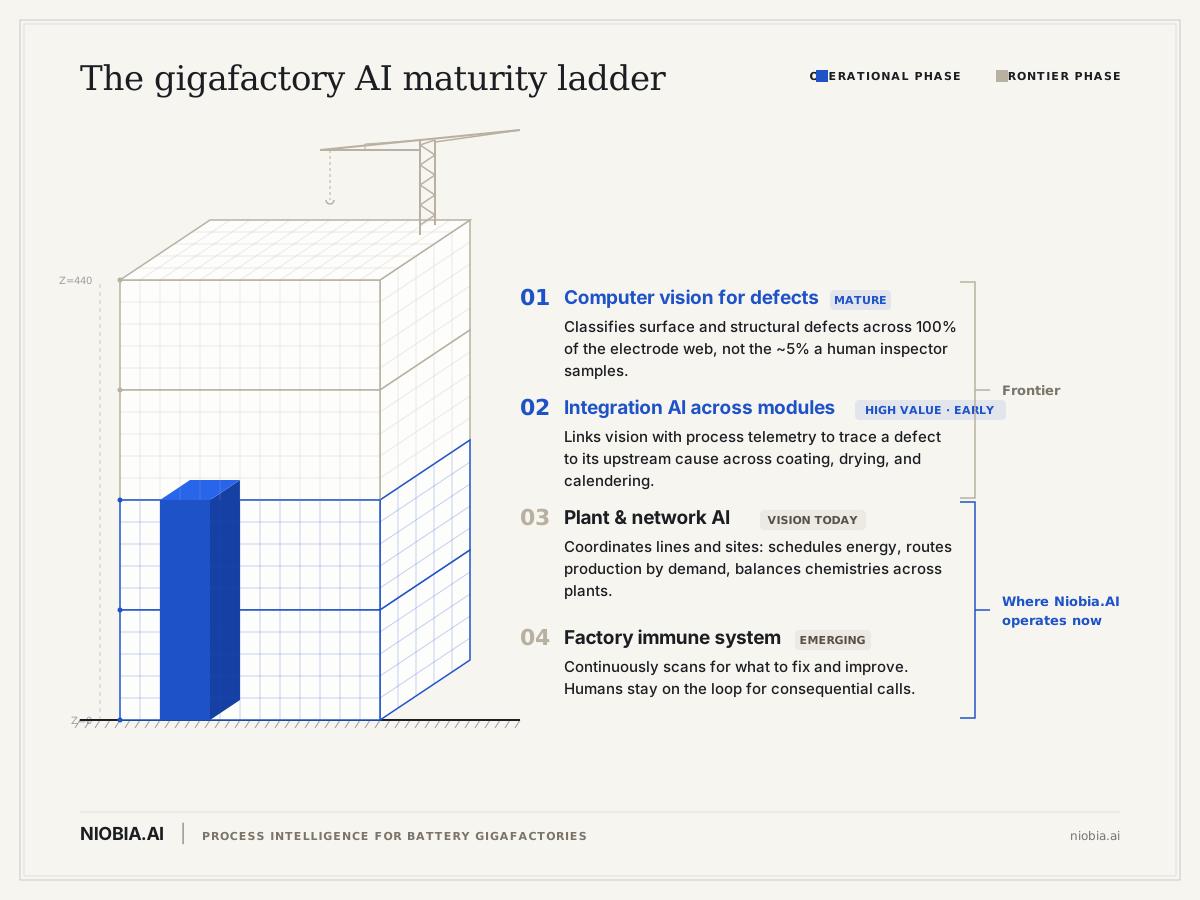
Level 1: Computer vision for visual defects
This is the mature rung. Convolutional neural networks, a class of deep learning model built for images, reliably classify electrode defects from images well enough to separate good from bad[9]. The advantage over human inspection is coverage. A line-scan vision system sees 100 percent of the electrode web, while a human inspector samples roughly 5 percent. Niobia AI starts here, with vision that catches surface and structural defects across the full web rather than a sample of it.
Level 2: Integration AI across modules
This rung is where the real money sits, and where the field is still early. A defect rarely starts where it shows up. A drift in coating or calendering can surface as a problem two steps and 30 to 90 minutes downstream. Integration AI links vision-based defect classification with process telemetry, learning the relationship between, say, roll gap drift, temperature variance, and the defect signature that appears later. This is the core of Niobia AI. The platform correlates the defect to its upstream cause, cuts root cause analysis from the usual 3 to 5 days down to minutes, a 50x speedup, and when a new defect appears that fits no existing category, it catalogues it automatically with its visual signature, process context, and cell-level outcome.
Level 3: Plant and network-level AI
Higher up, AI coordinates across modules, lines, and eventually multiple plants. It schedules energy-heavy steps against grid pricing, routes production across sites by demand forecast, and balances which chemistry runs where. This rung is mostly vision today, not deployed practice.
Level 4: The factory immune system
The top rung is a system that constantly scans for things to fix and things to improve, like white blood cells for a production line, with humans kept in the loop on consequential calls. Early multi-agent systems in adjacent industries already show the shape of this. The direction is real. The full version, in a cell plant, is still ahead of us.
Where most gigafactory AI projects get this wrong
Most AI projects assume the defect is visible at the moment of inspection. The most dangerous ones are not. Many battery defects are latent. They are present but dormant, carry no electrochemical signature, and only activate later, often in the field after the cell ships[2]. A vision system that grades a cell as good today can be wrong in two years. This is why detection alone is not enough, and why correlating process conditions with eventual outcomes matters more than any single image.
The second mistake is assuming clean, stable inputs. Battery chemistry drifts with humidity, slurry age, roll wear, and temperature, so a model tuned to last week's conditions quietly makes scrap today. The third is treating defects as equally costly whenever caught. They are not. Catching a problem upstream wastes a coated electrode. Letting it escape is far worse. To put a number on it, 2D X-ray inspection costs about $0.05/kWh, while a 2.5 percent pack field failure during warranty costs about $7.50/kWh, an asymmetry of roughly 150 to 1[2]. The plants that win are the ones that catch drift early, account for the latent defects no camera can see today, and treat the cost of a late escape as the real number to optimize against. That is the gap Niobia AI was built to close.
Where LLMs and agents actually are right now
The honest state is early, hyped, and mostly pre-scale. An MIT study found only about 5 percent of generative AI projects reach scale across industries, and Gartner expects over 40 percent of agentic AI projects to be cancelled by the end of 2027[13]. At the same time, the trajectory is steep, with Deloitte projecting agentic AI adoption in manufacturing to roughly quadruple through 2026, from 6 percent to 24 percent[13]. The framing the field has settled on is a shift from human-in-the-loop, where a person approves each action, to human-on-the-loop, where agents reason, plan, and act under human oversight[14].
The sequencing question matters more than the hype. The first processes to make agentic are the bounded, measurable, lower-consequence ones: defect inspection and anomaly detection, then predictive maintenance, then closed-loop control on stable steps. Decisions that touch cell chemistry stay human-on-the-loop the longest, because the safety cost of a wrong autonomous call there is a field failure, not a rework. Build trust from the low-risk rungs up. That is the path, and it is the one Niobia AI is built to walk with a plant rather than ahead of it.
The bottom line
AI in a battery gigafactory exists to protect yield, because yield is where the money is. Early scrap runs 15 to 30 percent and each point costs roughly €30,000 per day, while Chinese plants already run under 10 percent scrap against a 30 to 40 percent global average[1,3]. The lever that closes that gap is speed of learning, not cheaper labor. Niobia AI cuts root cause analysis from 3 to 5 days to minutes, a 50x speedup, covers 100 percent of the electrode web instead of a 5 percent human sample, and catalogues every new defect with its process context, so a Western gigafactory can compress a learning curve it cannot afford to wait out.
About the author
Dr. Gaurav Jha is the Founder of Niobia AI, which builds AI-powered defect detection and process intelligence platforms for battery gigafactories. His PhD focused on fast-charging niobium pentoxide (Nb₂O₅) based nanostructured anodes, with broader research spanning gas sensors, ion sensors, and energy storage materials. At Intel, he worked on wet etch defect reduction in 5nm and 7nm chip fabrication, developing a hands-on instinct for process root cause analysis at scale that translates directly to electrode manufacturing.
He returned to batteries to develop one of the first large-scale lithium-sulfur cathode coatings at Lyten, then moved to Sila Nanotechnology where he worked on silicon anode particles for high energy density and fast-charging applications across consumer electronics and automotive programs. Across these roles, Dr. Jha led manufacturing scaleup from lab to high-volume production, conducted industrial root cause investigations, commercialized key materials products, and developed new electrode chemistries from first principles. He founded Niobia AI to bring that depth of manufacturing and materials science experience into an AI platform built specifically for the production floor.
References
- Bockey, G., & Heimes, H. (2024). Mastering Ramp-up of Battery Production [White paper]. Fraunhofer FFB & PEM, RWTH Aachen University. ffb.fraunhofer.de
- Attia, P. M., Moch, E., & Herring, P. K. (2025). Challenges and opportunities for high-quality battery production at scale. Nature Communications, 16, 611. https://doi.org/10.1038/s41467-025-55861-7
- S&P Global Mobility. (2025). Why Europe is losing the gigafactory race to China. spglobal.com
- International Energy Agency. (2025). Electric vehicle batteries. In Global EV Outlook 2025. iea.org
- Thunder Said Energy. (2025). Battery gigafactory capex costs. thundersaidenergy.com
- Stanford Center on China's Economy and Institutions. (2025). It's not just subsidies: How China's EV battery firms learned their way to dominance. sccei.fsi.stanford.edu
- Exyte. Reducing the energy consumption of battery cell gigafactories. exyte.net
- Franco, A. A., et al. (2025). Transfer learning assessment of small datasets relating manufacturing parameters with electrochemical energy cell component properties. npj Advanced Manufacturing, 2(1), 14. https://doi.org/10.1038/s44334-025-00024-1
- Badmos, O., Kopp, A., Bernthaler, T., & Schneider, G. (2020). Image-based defect detection in lithium-ion battery electrode using convolutional neural networks. Journal of Intelligent Manufacturing, 31(4), 885–897. https://doi.org/10.1007/s10845-019-01484-x
- Applied Materials. (2025). Improve yield learning with yield and defect management solutions [Applied SmartFactory]. appliedsmartfactory.com
- Manufacturing Dive. (2025). Will the US ever have fully automated 'dark factories'? manufacturingdive.com
- Control.com. (2020). Lights-out manufacturing: Industrial automation and the future. control.com
- Dataiku. (2026). Manufacturing's 2026 mandate: From AI pilot to agentic profit. dataiku.com
- The dawn of agentic autonomy: Defining the 2026 smart factory. (2026). ManufacturingTomorrow. manufacturingtomorrow.com